




Missed Calls Leave $44,800 per Physician on the Table. Here's How Specialty Practices Capture It.
Specialty practices miss 18% of patient calls in office hours and 81% after hours. See the cost per physician and how voice AI books every call.

Patient access is the top unsolved operating problem in outpatient care right now, and the data backs that up before you even talk to a vendor. MGMA's own members ranked no-shows as their single biggest patient access priority heading into 2026 — ahead of online scheduling, phone access, and wait times combined.
If you run patient access for a multi-location group, you already know why: every empty slot is unbilled revenue, every long hold time is a patient who calls a competitor instead, and every scheduling fix that stops at "get the calendar full" quietly ignores whether that visit ever gets paid for.
This guide is for the VP of Patient Access who's past the pitch decks and wants the actual numbers: what's broken, what "AI scheduling" really automates, and where the category still falls short of the problem it claims to solve.
"Patient access" has quietly become a euphemism for several distinct, expensive failures stacked on top of each other. The numbers:
None of this is a staffing problem you can hire your way out of. Adding headcount to a broken process just adds more people to a broken process.
Traditional scheduling (phone calls and manual calendars) is riddled with problems that compound each other. The average hold time in a healthcare call center runs over four minutes, and 34% of patients have given up on booking an appointment because they couldn't get through. Every missed call represents roughly $200 in lost revenue for a typical practice, and unanswered calls alone cost the average clinic an estimated $97,000 a year.
Manual scheduling is also error-prone — double bookings, no real-time visibility into last-minute cancellations, and no consistent way to check whether the patient booked is actually eligible for the visit before they walk in. The entire system creates friction for staff and patients alike, and it's the reason 27% of MGMA members named no-shows their top 2026 access priority, narrowly ahead of online scheduling (24%), phone access (22%), and wait times (21%).
AI patient scheduling uses conversational AI to automate the appointment lifecycle (phone, text, and web) from first contact through confirmation. Instead of a patient waiting on a human receptionist, an AI agent handles the conversation directly: finding open slots, booking or canceling appointments, sending reminders, and predicting which patients are at elevated risk of no-showing, based on appointment history, lead time, and time of day.
Missed appointments cost the U.S. healthcare system an estimated $150 billion every year. AI patient scheduling tackles this head on with no show prediction.
With 32% of medical groups already seeing no-shows climb in 2026, predictive no-show scoring isn't a nice-to-have — it's how a practice decides where to spend its limited reminder and outreach capacity. By analyzing factors like appointment history, time of day, and lead time, AI models can identify patients who are at a high risk of not showing up. With this insight, clinics can take proactive steps, like sending extra reminders or strategically double booking, to reduce missed appointments by 30 to 40%.
When a patient cancels last-minute, that empty slot is lost revenue. MGMA's data show a 19.95% average cancellation rate and only 27.4% of canceled visits get rebooked within 30 days under manual processes. Real-time schedule adaptation means the moment a cancellation hits the EHR, the AI is already working the waitlist by text or call, often filling the slot in under five minutes.
Clinics using this approach have rebooked up to 95% of canceled slots, against roughly 15% typically refilled manually.
▶ Case Study: How Frederick Foot & Ankle Reduces Scheduling Calls by 70% with Prosper AI
In a multi-location, multi-specialty group, getting the patient to the right clinician matters as much as getting them an appointment at all. Provider-patient matching pairs patients with the most appropriate provider based on need, specialty, location, and preference — language or gender included. Since 76% of patients are comfortable seeing an alternate provider for a faster appointment, smart matching uses that flexibility to get patients seen sooner rather than waiting for one specific provider's calendar to open up.
Resource utilization optimization analyzes the full schedule to minimize gaps, cluster similar appointment types, and smooth patient flow — avoiding the "empty waiting room, then overflowing waiting room" cycle. Health systems like Penn Medicine have increased patient volume 25% without adding staff, simply by optimizing existing capacity. This includes overbooking optimization, where AI intelligently overbooks specific slots based on no-show risk scoring, rather than applying a blanket overbooking policy across every appointment type.
By creating more efficient schedules and answering calls instantly, 24/7, AI scheduling directly attacks wait time — on the phone and for the appointment itself. One health system that integrated an AI scheduling agent saw an 89% drop in call abandonment because average speed to answer dropped to zero seconds. That matters given the trend line: appointment scheduling time is already up 19% since 2022 across major metros, and every minute a patient spends on hold is a minute closer to abandoning the call altogether.
Beyond operational efficiency, this technology fundamentally creates a better, more modern experience for patients.
Many patients prefer booking online, and 40% of all appointments are booked after business hours. Self-scheduling meets that demand directly — booking, rescheduling, or canceling on the patient's own time, through a web portal, app, or conversational phone agent — and captures requests that would otherwise be lost to voicemail. Tebra's 2026 data confirms it: 69% of patients want to reschedule online without calling anyone.
SMS messages have a 97% open rate, most within three minutes. SMS-based scheduling puts reminders, confirmations, and waitlist offers directly into a channel patients already check constantly — 89% say they want the ability to reschedule via text.
Interactive, two-way reminders that let patients confirm or cancel directly increase confirmation rates by 45% compared to one-way messages. Given that MGMA's own members expect no-shows to stay a top-three access problem through 2026, a reminder system that only broadcasts — rather than lets the patient act — is leaving confirmation rate on the table.
Implementing an AI patient scheduling solution might sound complex, but modern platforms are designed to integrate smoothly into existing workflows.
For an AI scheduler to be trustworthy, it has to be perfectly in sync with the practice's calendar of record. That means two-way integration with the EHR: any appointment the AI books appears instantly in the system, and any change staff make is immediately visible to the AI — no double bookings, no manual re-entry.
Leading platforms integrate with dozens of EHR and PMS tools, including athenahealth, Epic, ModMed, eClinicalWorks, and Veradigm.
Scheduling rarely happens in isolation. It involves insurance verification, referral checks, and increasingly, prior auth status. Agent orchestration coordinates multiple specialized AI agents through a single workflow: one agent takes the call, hands off to another to verify benefits with the payer, then confirms the appointment and sends a text — all without the patient repeating themselves or the practice adding a second phone call to the process.
Contact center integration embeds the scheduling agent directly into the existing phone system, so it answers instantly, handles routine requests, and transfers complex queries to a live agent with full context. That frees staff for the calls that actually need a human, rather than the ones that just need a calendar.
The ROI of AI scheduling shows up across three distinct KPIs, and the third is the one most practices aren't measuring yet.
These savings and revenue gains mean the technology often pays for itself in a matter of months.
▶ Case Study: How Northern Illinois Foot & Ankle avoided $350K in hiring costs with Prosper AI
Adopting new technology in healthcare requires careful consideration of security, regulations, and fairness.
Any system that handles patient information must be HIPAA compliant. Reputable AI scheduling vendors provide a Business Associate Agreement (BAA) and use robust security measures like end to end encryption and access controls. It’s also important to choose vendors with strong security credentials, such as a SOC 2 Type II audit.
AI scheduling tools are administrative, not clinical, so they don't require FDA clearance. They do need to comply with communication laws like the TCPA, though healthcare-specific exemptions permit appointment-related communications as long as patients can easily opt out.
Access gaps aren't evenly distributed. In dermatology, Medicaid patients wait a median of roughly 13 days to book the same visit type that BCBS or Medicare patients book in about 7 days. A scheduling system that only optimizes for overall throughput can quietly widen that gap rather than close it.
Multilingual AI agents and phone-based options for patients without reliable internet access are what actually keep access equitable rather than just efficient on average.
AI models learn from historical data, which can encode existing disparities. A responsible system is monitored to ensure it doesn't use proxies like zip code as a stand-in for race or income, and allocates appointments based on medical need and patient preference — not demographics.
A full calendar and a healthy practice are not the same thing. A visit that gets booked, shows up, and then gets denied at the claim stage because eligibility wasn't checked properly isn't a win. It's the same revenue leak, just deferred a few weeks and now harder to trace back to its cause. Patient access tools that stop at booking are optimizing for a metric — appointments on the calendar — that doesn't actually predict whether the practice gets paid.
The practices closing the revenue gap are treating scheduling and revenue cycle as a single workflow, not two separate problems. That means eligibility verification, prior auth status, and patient billing on the same interaction as booking. It also means specialty-specific intelligence: dermatology no-show rates range 12–31% by clinic type, while OB/GYN averages 18% nationally — different root causes that a generic reminder cadence built for one will underperform on for the other.
Prosper AI's scheduling workforce is built around the idea that a full schedule and a financially cleared schedule are two different things. Prosper AI's agents work both sides of every visit — patients and payers — handling benefits verification, prior auth status, patient billing and estimation, and claim status alongside booking and reminders, so every appointment that lands on the calendar is one the practice can count on being reimbursed for.
The intelligence behind it is Prosper AI's knowledge graph built on 62,000 pathways across 27 specialties, over 190 million patient interactions, and proprietary data from over a million payer calls . It's specialty-specific by design — because a one-size-fits-all reminder cadence doesn't cut it when no-show patterns vary this much by specialty and clinic type.
Prosper integrates with 80+ EHR and practice management systems, deploys in a few weeks with $0 charged until go-live, and pairs every implementation with a forward-deployed AI consultant rather than a handoff to a CSM.
Ready to see it on your schedule? Book a demo with Prosper AI.
How does AI patient scheduling reduce no shows?
It combines three things: predictive risk scoring that flags likely no-shows before they happen, two-way automated reminders that let patients confirm or reschedule directly (which lift confirmation rates 45% over one-way messages), and self-scheduling that lets patients pick times that actually work for them. Given that no-show rates rose at 32% of medical groups in 2026, all three matter more than any single tactic alone.
Does filling the schedule guarantee the practice gets paid?
No, and this is the gap most scheduling tools don't address. Eligibility errors are the third-largest cause of claim denials industry-wide, and 41% of providers report at least 1 in 10 claims now get denied. A full calendar with unchecked eligibility is still exposed to denials weeks later. The best AI scheduling systems verify benefits and eligibility at the time of booking, so the goal is a financially cleared visit, not just a booked one.
Is AI patient scheduling secure and HIPAA compliant?
Yes, when built by a reputable vendor. Look for a signed BAA, end-to-end encryption, and independent security certification like SOC 2 Type II — and verify these credentials directly rather than taking marketing copy at face value.
Will AI replace my front desk staff?
No. The goal is to automate the routine, repetitive volume — bookings, reminders, eligibility checks — so staff can focus on complex patient needs and in-office experience, rather than spending hours a week on manual eligibility checks that, per Experian's 2025 data, already take over 10 minutes each for more than half of providers doing them by hand.
How long does it take to implement an AI patient scheduling system?
Implementation time varies by platform and practice complexity. Modern platforms with pre-built EHR integrations typically deploy in a few weeks. Ask any vendor specifically about their go-live timeline, how they handle exceptions during the build, and whether they charge before the system is live.
Can Prosper AI handle scheduling for multiple locations and specialties?
Yes. The agent can be configured with the unique rules, provider schedules, and appointment types for dozens of locations and specialties, ensuring the right patient is always booked with the right provider at the right place.
How is Prosper AI's scheduling agent different from a basic answering service or chatbot?
A basic answering service takes a message. Prosper AI's agent checks live provider availability, books directly into the EHR, and follows up automatically — no human relay required.
Does Prosper AI's scheduling agent work with our existing phone number and contact center software?
It should. Reputable platforms embed into your existing phone system and number so patients don't have to dial anything new, and pass context to live agents for calls that need a handoff.
Discover how healthcare teams are transforming patient access with Prosper.
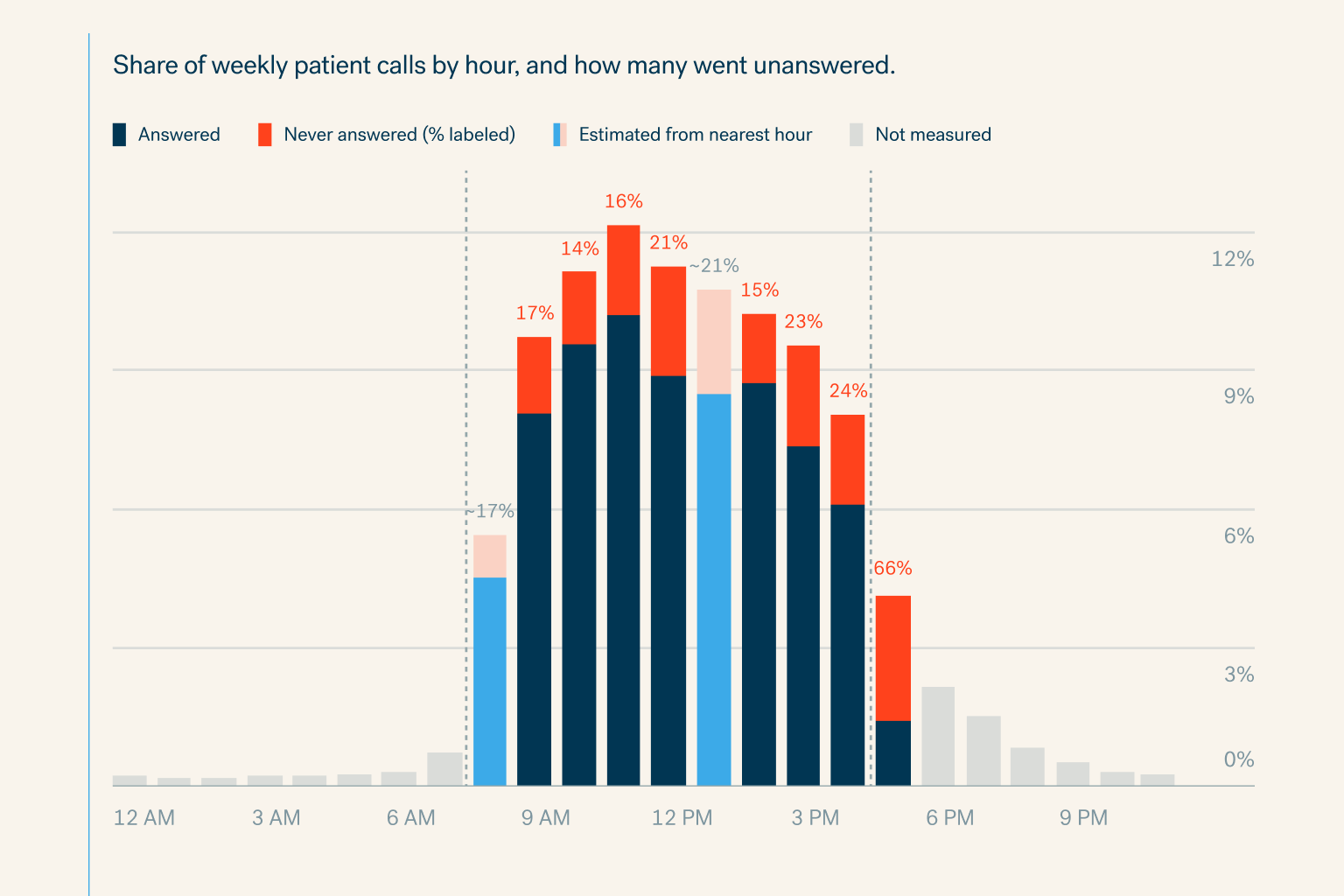
Specialty practices miss 18% of patient calls in office hours and 81% after hours. See the cost per physician and how voice AI books every call.
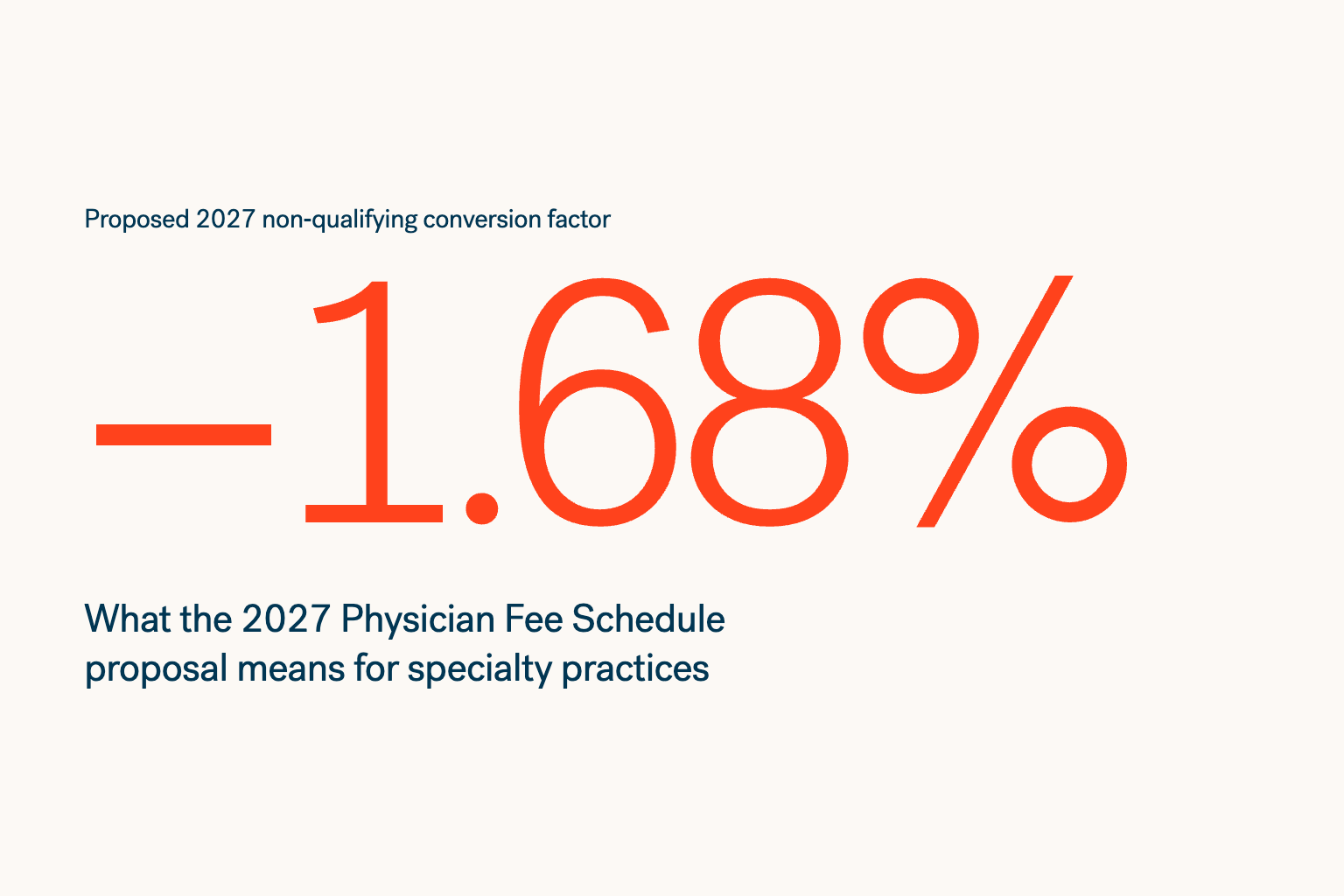
CMS proposes 2027 Medicare conversion factors down 1.19% to 1.68%. See the impact on specialty practices and the revenue levers you still control.
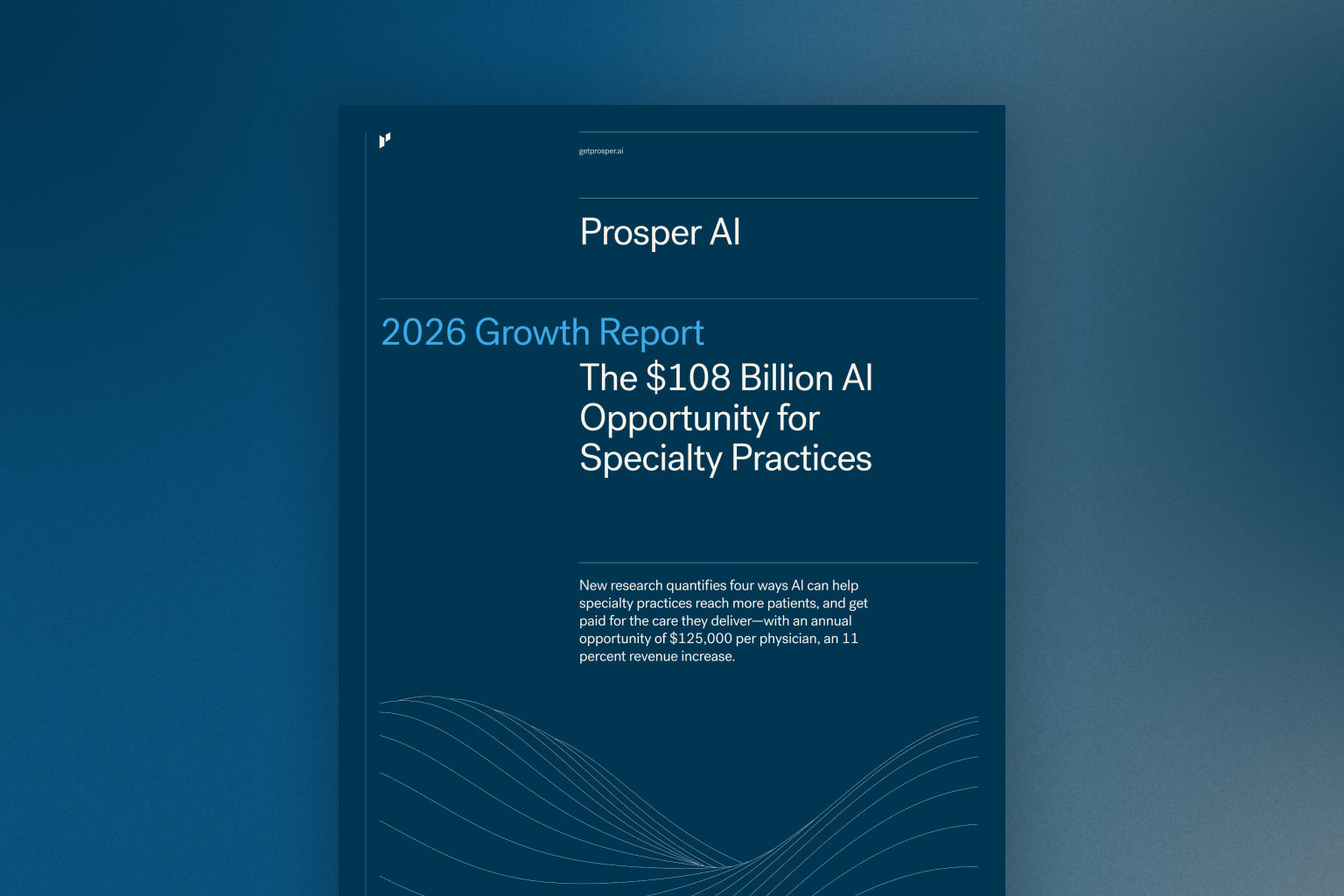
New research quantifies four ways AI can help specialty practices reach more patients, and get paid for the care they deliver—with an annual opportuni


